
University of Primorska
Faculty of Mathematics, Natural Sciences and Information Technologies
Datum / Date: 25.2.13
Čas / Time: 10:00-11:00
Predavalnica / Location: FAMNIT-SEMIN
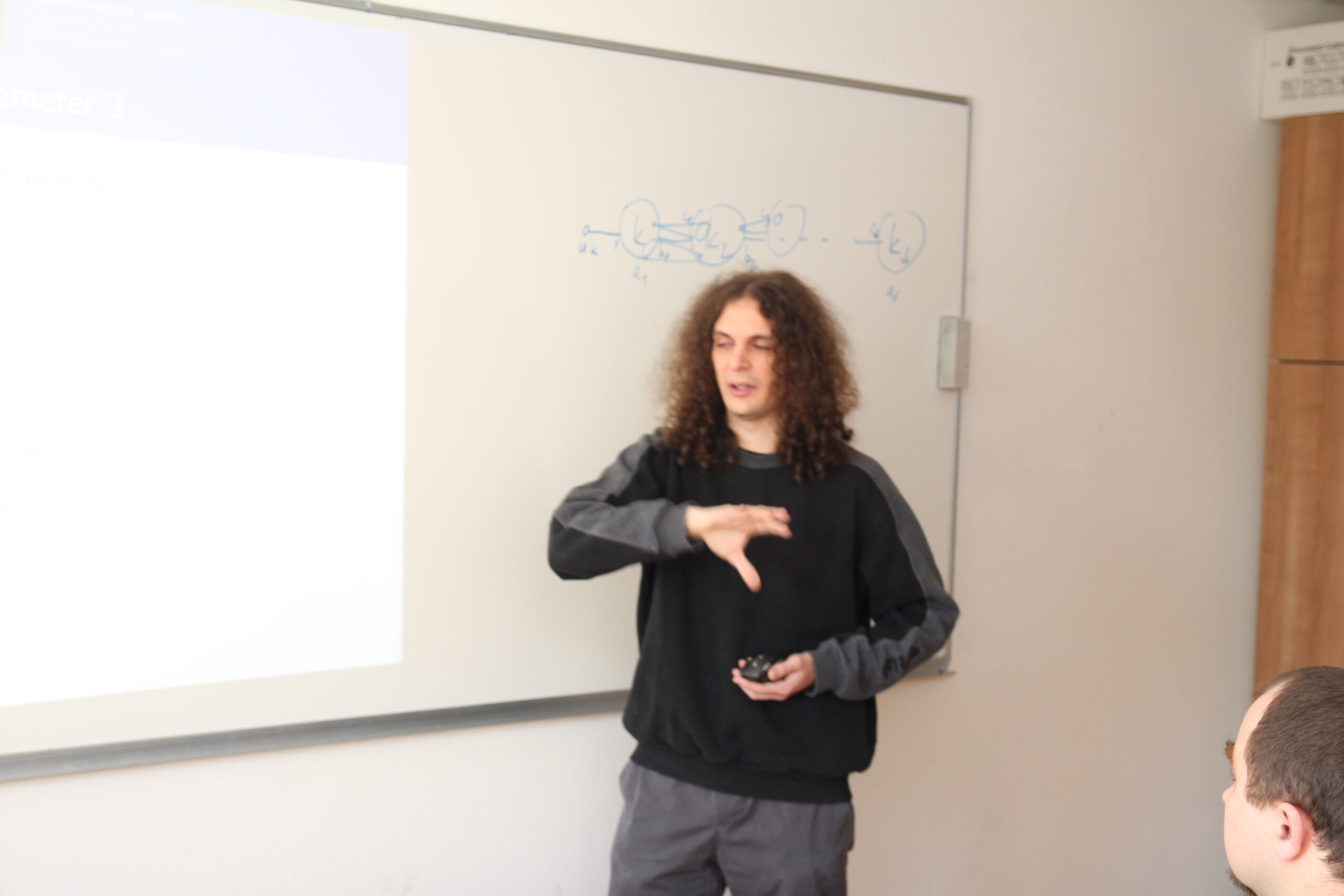
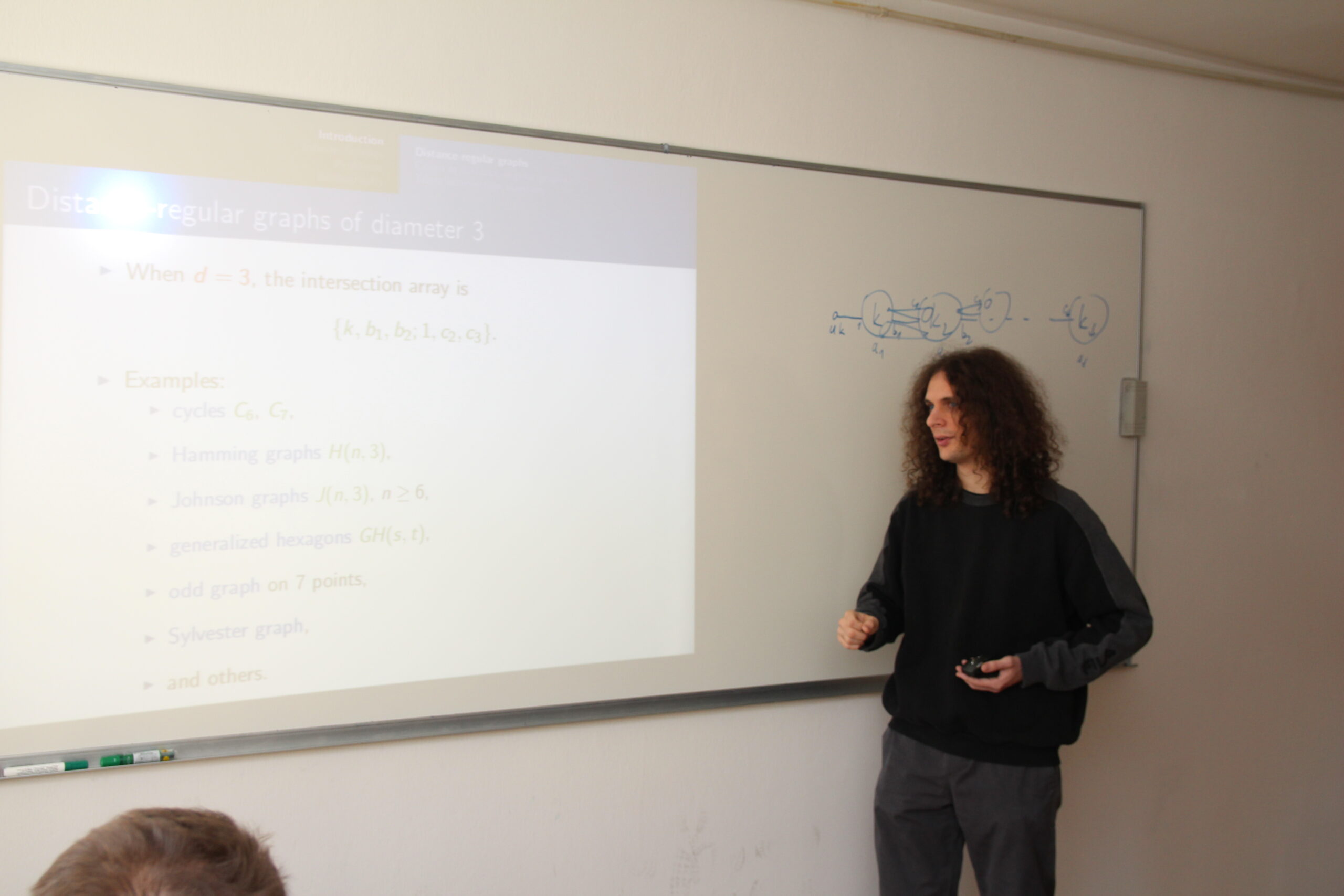
Predavatelj / Lecturer: Janoš Vidali (Univerza v Ljubljani, Fakulteta za računalništvo)
Naslov / Title: Extremal codes in distance-regular graphs with diameter 3
Povzetek / Abstract:
We study $1$-codes in distance-regular graphs of diameter $3$ that achieve three different bounds. We show that the intersection array of a distance-regular graph containing such a code has the form$\{a(p+1), cp, a+1; 1, c, a p\}$ or $\{a(p+1), (a+1)p, c; 1, c, a p\}$ for $c=c_2$, $a=a_3$ and $p=p_{33}^3$. These two families contain$10+15$ known feasible intersection arrays out of which four are uniquely realized by the Sylvester graph, the Hamming graph $H(3,3)$, the Doro graph and the Johnson graph $J(9,3)$, but not all members of these two families are feasible. We construct four new one-parameter infinite subfamilies of feasible intersection arrays, two of which havea nontrivial vanishing Krein parameter:$\{(2r^2-1)(2r+1), 4r(r^2-1), 2r^2; 1, 2(r^2-1), r(4r^2-2)\}$ and $\{2r^2(2r+1), (2r-1)(2r^2+r+1), 2r^2; 1, 2r^2, r(4r^2-1)\}$ for $r > 1$ (the second family actually generalizes to a two-parameter family with the same property).Using this information we calculate some triple intersection numbers for these two families to show that they must contain the desired code. Finally, we use some additional combinatorial arguments to prove nonexistence of distance-regular graphs with such intersection arrays.

Slides from the talk are available here: DOWNLOAD SLIDES!