University of Primorska
Faculty of Mathematics, Natural Sciences and Information Technologies
The European Commission’s Innovation Radar has highlighted three pioneering innovations developed within the REMEDY project, positioning the initiative at the forefront of next-generation sustainable building technologies.
The REMEDY project (Archibiome tattoo for resistant, responsive, and resilient cities) has been recognised by the European Commission’s Innovation Radar, an initiative that identifies and promotes high-potential innovations emerging from EU-funded research and innovation projects. Innovation Radar plays an important role in showcasing Europe’s most promising research results by identifying breakthrough technologies, connecting innovators with stakeholders, and helping accelerate the transition of scientific discoveries into market-ready solutions with societal impact.
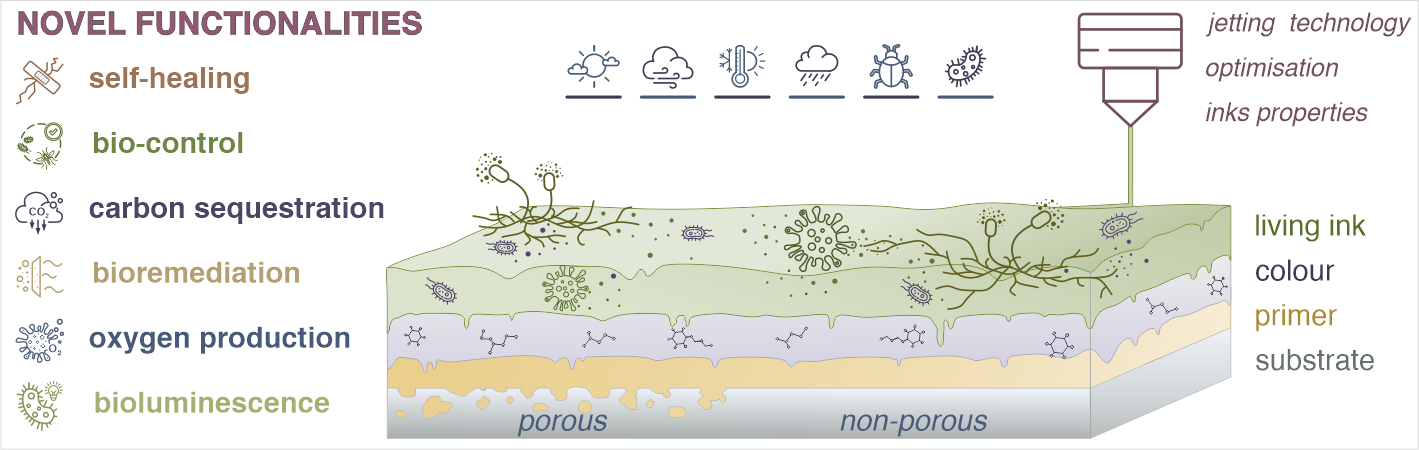
Led by the University of Primorska under the coordination of Dr Anna Sandak, the REMEDY project is developing a transformative approach to architecture by introducing the concept of probiotic architecture: buildings enhanced with engineered living materials that interact positively with their environment. REMEDY proposes the development of an archibiome tattoo – a new generation of living, high-resolution microbial inks that enable bespoke decoration and functionalisation of both new and existing building surfaces. Unlike conventional building materials, REMEDY’s engineered living systems are designed to provide active and adaptive functions, including improved environmental performance, microbial balance, carbon sequestration, oxygen production, and bioremediation. The three innovations recognised by Innovation Radar are:
1. Engineered living material systems for bio-active and adaptive building surface.
2. Engineered microbial systems for air purification, CO₂ capture, and antimicrobial building applications.
3. Printable bio-coating platform for applying functional microbial layers to building surfaces
The REMEDY consortium brings together expertise from leading academic and industrial partners:
- University of Primorska – Project coordinator
- University of Ljubljana
- Graz University of Technology
- Tiger Coatings
- Qres Technologies
- Xylotrade B.V.
Through this interdisciplinary collaboration, REMEDY aims to redefine the relationship between microorganisms and the built environment. By challenging the traditional perception of microbes as harmful agents, the project seeks to establish a new paradigm where microorganisms become active partners in creating healthier, more sustainable, and adaptive spaces.
“REMEDY represents a next step towards a future of regenerative architecture, where buildings are no longer passive structures, but living systems capable of interacting with and improving their surroundings,” said Dr Anna Sandak, REMEDY Project Coordinator from the University of Primorska. The recognition by Innovation Radar highlights the scientific ambition and innovation potential of REMEDY, supporting its vision of initiating a microbial revolution in architecture and advancing Europe’s leadership in sustainable, bio-based technologies.
About REMEDY
REMEDY is a European research project funded by the European Innovation Council (EIC) Pathfinder programme and part of the Engineered Living Materials (ELMs) portfolio. The project is developing innovative engineered living materials and biofabrication technologies for the next generation of sustainable and regenerative architecture. By combining microbiology, materials science, and advanced biofabrication approaches, REMEDY is creating functional microbial inks that can transform the design, performance, and perception of building materials.