University of Primorska
Faculty of Mathematics, Natural Sciences and Information Technologies
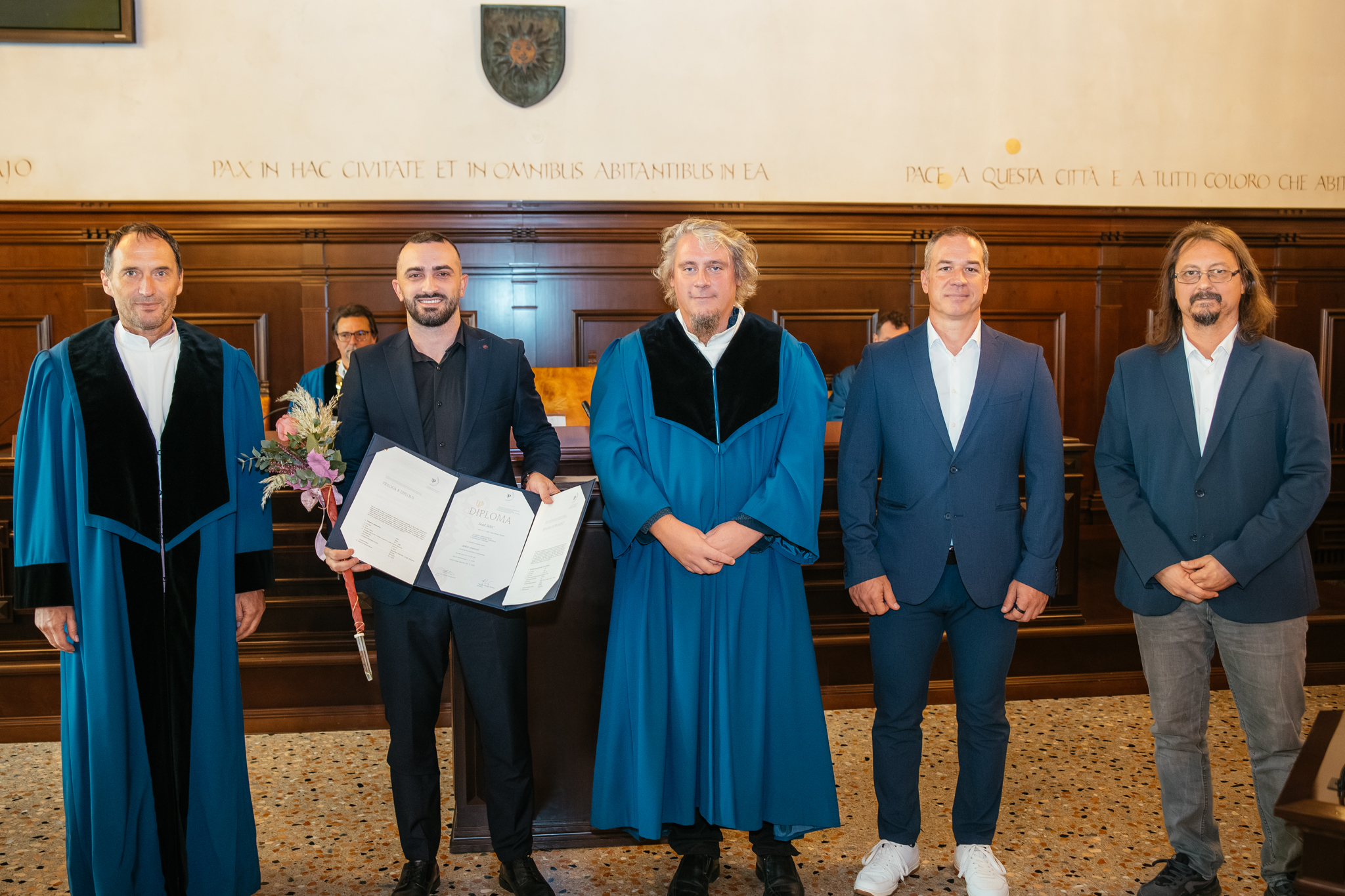
On Thursday, 22 October 2026, the UP held its autumn graduation ceremony for Doctors of Science. The Vice-Rector for Scientific Research and Development at the UP, Prof. Dr. Štefko Miklavič, together with the deans of the member faculties and mentors, promoted 12 new doctors of science, who joined the ones who had completed their doctoral studies at the UP.
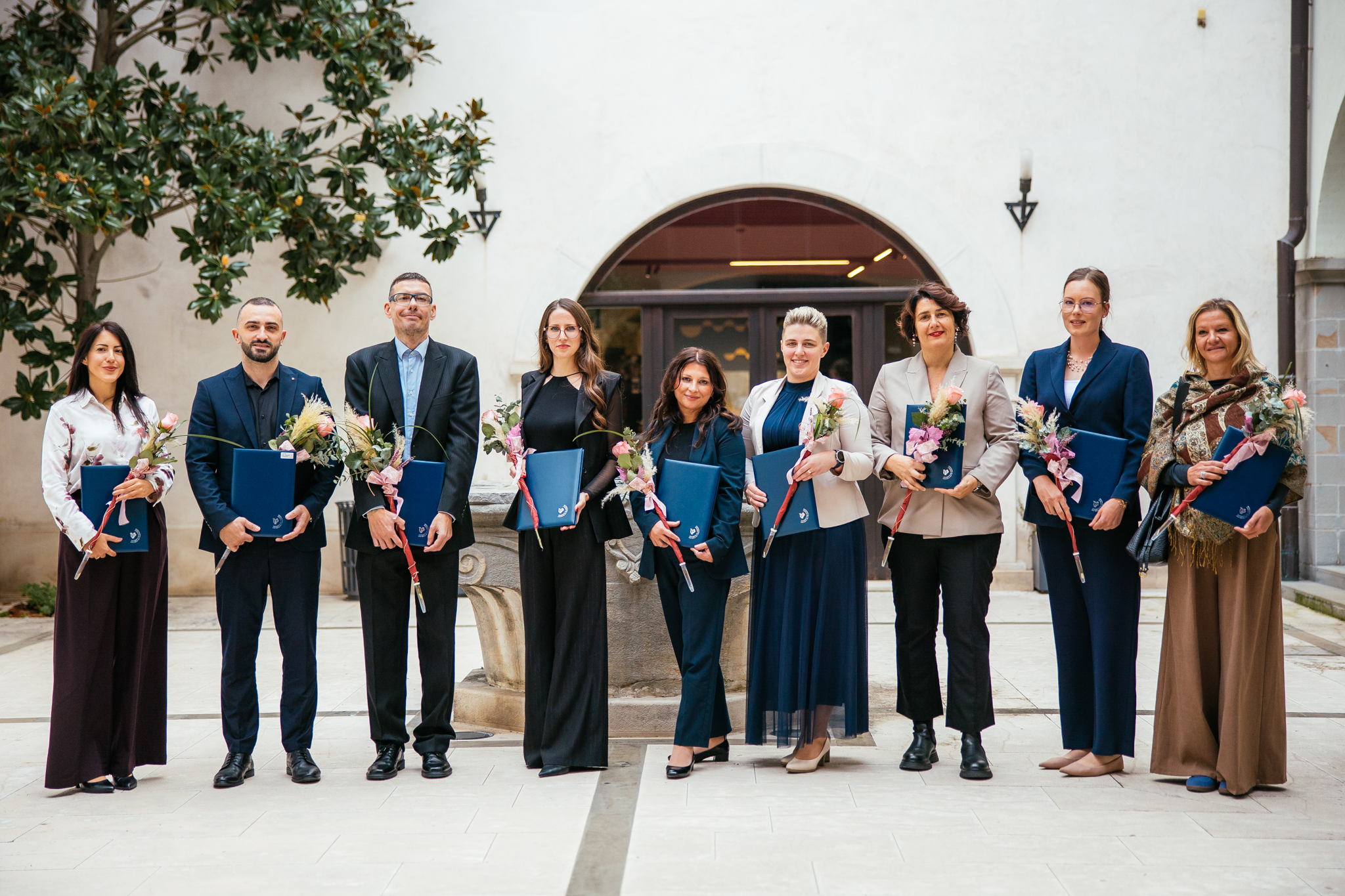
On this day, the following were promoted at UP FAMNIT:
Sead Jahić defended his doctoral dissertation at the UP FAMNIT entitled »Sentiment Analysis of the Bosnian Language« under the mentorship of prof. dr. Jernej Vičič and co-mentorship of izr. prof. dr. Branko Kavšek.
Doctoral dissertation summary
The doctoral dissertation addresses the development of methods for sentiment analysis in the Bosnian language, integrating machine learning, language technologies, and neural networks. The research resulted in the development of the first Bosnian sentiment lexicon, as well as new datasets and linguistic resources that provide an important foundation for further research in Bosnian natural language processing. Four machine learning models were developed and evaluated, together with approaches for addressing negation, intensifiers, and other linguistic characteristics that influence sentiment interpretation. The experimental results confirm the applicability and effectiveness of the proposed methods and demonstrate their potential for improving automated sentiment analysis. The dissertation contributes to the advancement of computational processing and understanding of the Bosnian language and provides valuable resources and methodological foundations for future research in sentiment analysis and Bosnian language technologies.
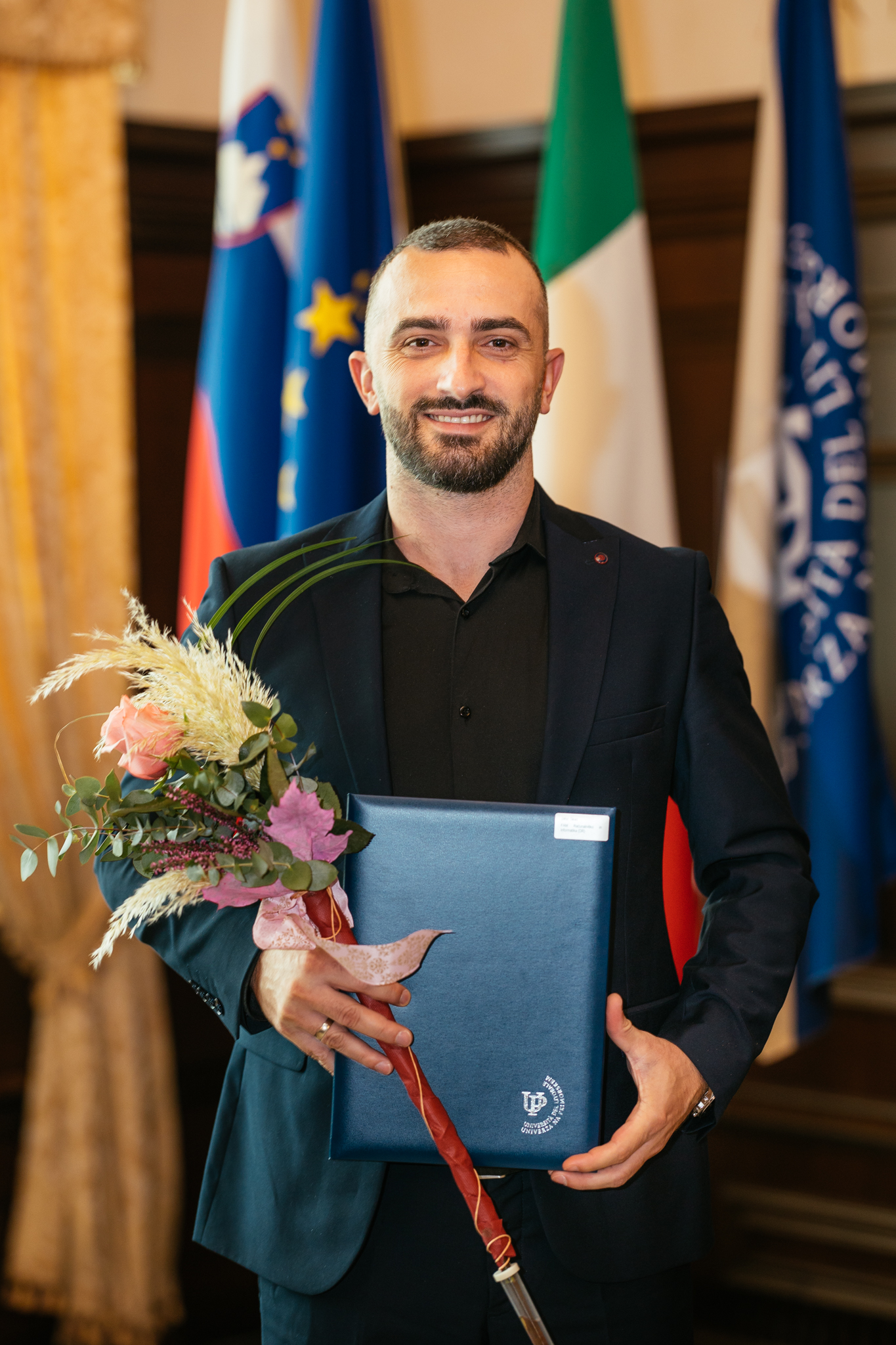
Gregory Caldwell Robson defended his doctoral dissertation at the UP FAMNIT entitled »Automorphisms of bicoset digraphs and an alternative BCI problem« under the mentorship of prof. dr. Edward Tauscher Dobson.
Doctoral dissertation summary
We investigate structural and symmetry-related properties of bicoset digraphs, focusing on connected cases that are X-joins with collections of empty digraphs. For such digraphs, we show that their automorphism groups can be derived from their natural irreducible quotients and that they can be recognized from their connection sets. We then connect this framework to a generalized version of the BCI problem, which classically asks whether two Haar graphs of a group G are isomorphic precisely when related by a specified family of isomorphisms. We present a theoretical solution to the isomorphism problem for the proposed generalization, and, in the abelian case (with one exception), reduce it to the isomorphism problem for a related quotient, component, or corresponding Cayley digraph. For Haar graphs of abelian groups of odd order with symmetric connection sets (S = -S), the exception does not occur, and in particular, for cyclic groups of odd order with such sets—as well as certain other classes—we completely solve the isomorphism problem.
Filip Majstorović defended his doctoral dissertation at the UP FAMNIT entitled »Molecular-Level Wood-Water Interactions: The Role of Hydrogen Bonding and Cell Wall Free Volume« under the mentorship of prof. dr. Bohumil Kasal and co-mentorship of prof. dr. Matthew John Schwarzkopf.
Doctoral dissertation summary
By means of near-infrared spectroscopy and a technique that tracks nanoscale empty spaces in materials, it was found that water changes its behavior once wood reaches about 10% moisture content: below this point, water bonds tightly to the wood’s structure, while above it, they increasingly cluster with other water molecules. This shift, driven by tiny pockets of open space in the cell wall expanding and merging, explains why wood absorbs much more moisture above a certain humidity. The findings point toward better ways to protect wood from moisture and decay, which grows ever more relevant as wood replaces concrete and steel in construction.