University of Primorska
Faculty of Mathematics, Natural Sciences and Information Technologies

Seven researchers from UP FAMNIT and UP IAM have been included in the international list of the most influential scientists for 2025. Their rankings reflect the international recognition of scientific work in the fields of artificial intelligence, biomolecular chemistry, sustainable materials, forestry, and the built environment.
A total of twelve researchers from the University of Primorska have been featured on the World’s Top 2% Scientists list, compiled by Stanford University and Elsevier publishing. The list is based on a publicly available database of standardized citation indicators for scientists, published in the Elsevier repository.
From Biomolecular Chemistry to Artificial Intelligence
Among the featured UP FAMNIT researchers in the field of medical and biomolecular chemistry are Prof. Dr. Janez Konc and Prof. Dr. Dušanka Janežič. In the field of artificial intelligence and image processing, Prof. Dr. Marko Tkalčič was included for his research on the use of advanced data analysis methods to identify patterns, extract information from complex databases, and develop intelligent systems.
In her research on protein function and its role in disease development, Prof. Dr. Dušanka Janežič combines the fields of mathematics, chemistry, biology, and computer science. Together with Prof. Dr. Janez Konc, they developed the computational method ProBiS, which enables the identification of binding sites on proteins and the prediction of their potential ligands. “The method opens up new possibilities for discovering potential targets and developing drugs, including through the use of protein structures predicted by artificial intelligence,” she adds.
Science for a sustainable future
Research groups at UP IAM InnoRenew CoE focus their scientific efforts primarily on various aspects of materials, wood, forestry, and the built environment. Prof. Dr. Andreja Kutnar and Assoc. Prof. Jakub Sandak are listed in the field of agriculture, fisheries, and forestry, Prof. Dr. Bohumil Kasal in the field of building and construction, and Assoc. Prof. Dr. Anna Sandak in the field of chemistry.
Wood research and research on other renewable materials connects fundamental knowledge with the practical challenges of construction, industry, the built environment, sustainability, and the needs of modern society. Collaboration among experts in chemistry, biology, and civil engineering enables a more comprehensive understanding of materials as well as the development of solutions for a more sustainable use of natural resources.
Assoc. Prof. Dr. Anna Sandak focuses her research on an emerging interdisciplinary field, developing Engineered Living Materials (ELMs) for construction that integrate materials science, biotechnology, architecture, and engineering. In 2022, her research group launched the ARCHI-SKIN project, funded by the European Research Council (ERC), which explores the potential of developing fungal biofilms into living protective coatings. “An important next step is represented by the REMEDY project, funded under the EIC Pathfinder program, which aims to bring engineered living materials closer to the market,” she adds.
What does such a ranking mean?
The August 2026 database update includes data up to the end of 2025, using Scopus profiles available as of August 1, 2026. The database provides insights into both long-term scientific impact and impact in the most recent single year. Evaluation takes into account more than just the number of publications or citations; indicators also include information on co-authorship, author positions on publications, and other bibliometric characteristics. Scientists are categorized into 20 broad scientific fields and 174 sub-fields, enabling comparison across different research disciplines.
For Prof. Dr. Dušanka Janežič, inclusion in the top 2% of the world’s most influential scientists is a great recognition of many years of work and a confirmation of the importance of scientific collaboration. “The fact that twelve professors from the University of Primorska are included on the list is a major success for our university and proof of the quality and international impact of the research we develop here.”
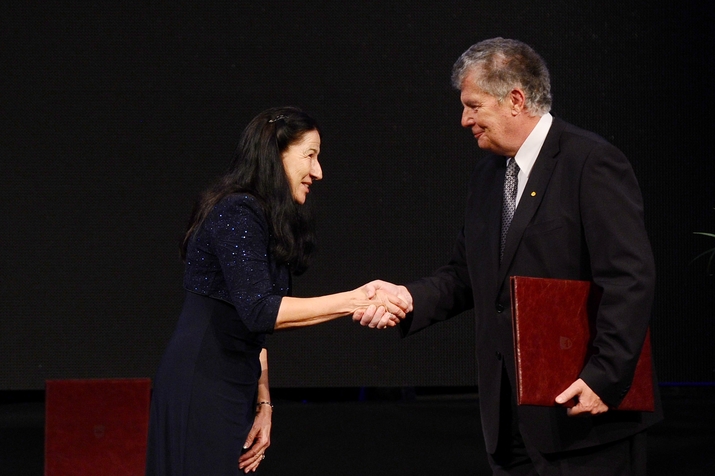
Assoc. Prof. Dr. Anna Sandak notes that she is particularly proud of her contribution to establishing and developing a research field that bridges biological systems and the built environment, adding that “being included on the list for two consecutive years is an encouraging recognition of past work and the potential of interdisciplinary research to develop practical solutions.”

Our sincere congratulations to all included researchers for the international recognition of their scientific work!