University of Primorska
Faculty of Mathematics, Natural Sciences and Information Technologies
At the second Tea Talk, entitled Parents in Sport – A Sports Psychology Perspective, we were joined by Prof. Tanja Kajtna, PhD, a sports psychologist.

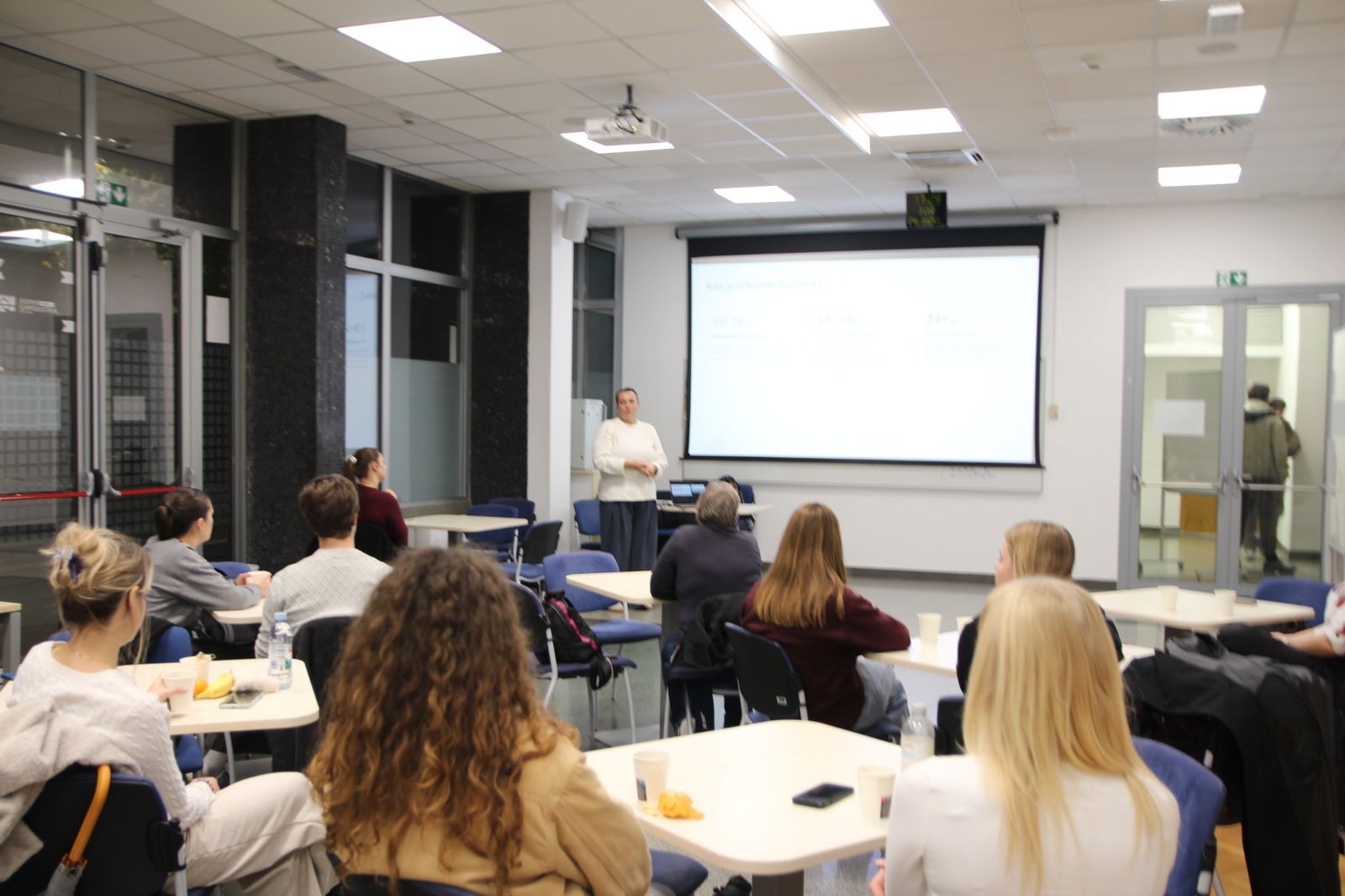
Working with the parents of athletes is also an important part of sports psychology. It could even be considered one of the key elements in the development of a sports career. During the lecture, the speaker emphasised that this primarily involves raising coaches’ awareness of how to work with parents, as this often presents a considerable challenge for them. On the other hand, it is also important to raise parents’ awareness directly, for example through workshops specifically designed for parents. We also frequently engage with parents when planning young athletes’ careers and aligning their expectations regarding their children’s sporting development with the actual wishes of the young athletes. The speaker also provided some practical advice on working with parents who are also their children’s coaches.
Following the lecture, we spoke with the speaker about the important role parents play in the development of their children’s sporting careers.
How important a role do parents play in the development of young athletes’ sporting careers?
“Parents are among the key people who usually introduce children to sport. They then help them not only choose a sport, start learning it and develop a love for it, but also support them when things get difficult – sometimes encouraging them to go to training even when they do not feel like it. In fact, they are the first people who provide the practical means for children to participate in sport.
Unfortunately, all sports are becoming increasingly expensive, while sponsorship opportunities usually only become available once children are old enough and their results have gained public recognition. Until then, parents are the main sponsors, and their role is becoming increasingly important. Of course, however, financial support will never outweigh the emotional role of parents, which is fundamental and exceptional. We see this when athletes run into their parents’ arms after major competitions. Parents are usually their first and greatest supporters throughout their lives.”
Where is the line between parental support and putting too much pressure on a young athlete?
“As long as the child’s wishes come first, parental support is appropriate and effective. However, if parents’ wishes become more important or the child’s wishes are no longer taken into consideration, this can start to have a negative impact on the child. This can become apparent, for example, when children want to switch to a different sport.
Sometimes, finding a delicate balance is necessary. If a child says after three weeks that they no longer want to train, perhaps because they are not getting along with their peers in the sports group, this does not necessarily mean it is time to quit. In such cases, we do not immediately act on the child’s wishes. However, if a child says, a year or two after the end of the season, that they are no longer interested in the sport, we need to listen to them.
The boundary therefore depends on the individual, but children and their decisions must always come first. Even a very young child knows whether they feel comfortable participating in a particular activity or not.”
Can excessive parental expectations also affect children’s motivation and enjoyment of sport?
“Yes, but parents are usually not the ones who create the greatest pressure. Athletes often put the most pressure on themselves. Parents are therefore not necessarily the ones applying the most pressure.
Of course, today we also discussed a few extreme cases in which parents behave in truly inappropriate ways. However, in the vast majority of cases, parents are actually supporters and a safe haven to which children can turn.”